The Last Hangout
We came to a stop at the light on Van Brunt Street in Red Hook, Brooklyn, and in front of us was a building with a familiar name splashed on its exterior: Tesla. This site, though, was once the location of Goltens, an engine repair company servicing the marine industry in New York City. A place where skilled tradesmen like my father, a machinist, would engineer, repair, and recondition ship components, with the skyline of Manhattan not too far in the distance.
At that time, during the early 1970’s, my father was a young man, having recently emigrated to the United States from Canada and a newlywed. He once described those early years to me as “perfect, with everything happening so smoothly.” He lived in Carroll Gardens, a then-Italian and Puerto Rican immigrant neighborhood, first, on Nelsen Street, and later on President’s Street, and walked to work. He made a decent salary, enough to live well.
Now, at the red light, the Tesla car showroom was a sign of the times, with technology fast replacing manufacturing and the type of work and workers that go with it. I looked at my father from the side, his hands very familiar to me. They were worker’s hands with cracked skin, prominent veins, and in his case, a black spot on one of his nails, probably from a minor tool injury. I wondered if he was thinking about those days.
His eyes were puffy, the result of months of lost sleep. Although he had recovered nicely from recent, successful surgery, the diagnosis of his illness had paralyzed his spirit. He was living his worst nightmare and a fear of death had permeated his being.
The light turned green and we headed towards Atlantic Avenue, to look for parking near the corner of Court Street, where some items needed to be picked up at Trader Joe’s. My father did not like looking for parking and I have a funny story to tell about this. For many years, at least until I was a teenager and approached him about it, When I was a kid, and as a result of his imperfect English, my father would refer to the activity of looking for a parking space as “looking for a park,” which obviously had a very different meaning. Whenever he would roll up the car window, I watch would watch in anxious anticipation, seemingly slow-motion, as he would ask a stranger where he could “find a park.” I both cringed and-like a little Scorpio child who revels in sarcastic humor, laughed internally at the whole scenario. Eventually, had the courage to correct him.
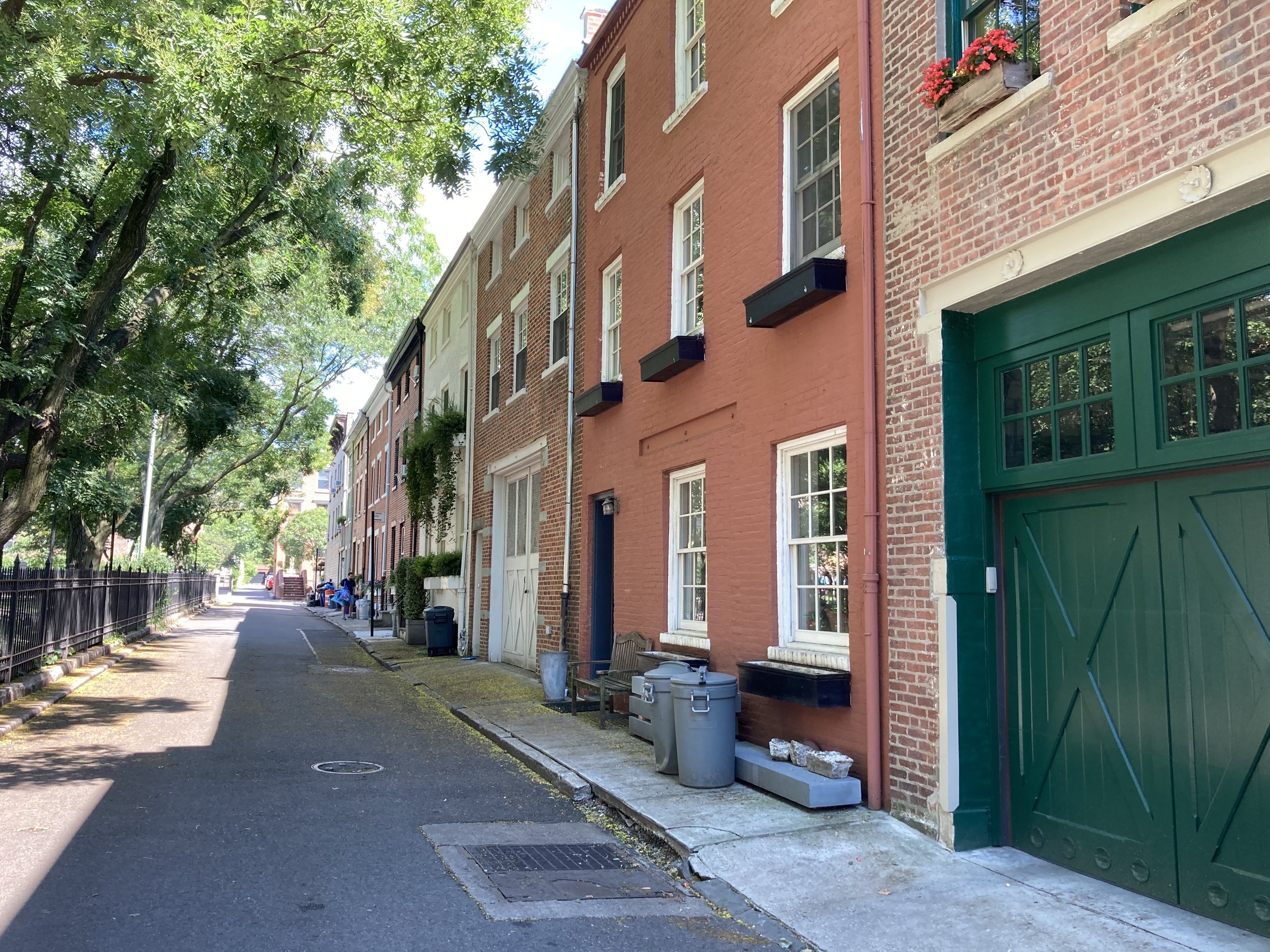
We would generally “look for a park” on Kane Street or sometimes near the Carroll Street Playground, a rare oasis in the urban density of this Brownstone neighborhood. I enjoyed those times with my father immensely. It offered a rare father-daughter hangout opportunity, usually on a Sunday, which often involved picking up a book that was being given away on the stoop (often just what I needed to read at the time), or making a random discovery, like bamboo fencing on the side of an elegant Queen Anne home.
Once we got to Trader Joe’s, my father would suggest that we separate and meet in an hour, giving me more time to explore the neighborhood, which, I was always ecstatic about, because those streets were the closest on this side of the Atlantic I got to my connecting to my ancestors, and my maternal grandparents to be exact, who also once lived in the area. There was Monteleone bakery, Roma pizza, and Mazzone hardware, places I knew only by name only but were part of my grandparents’ daily landscape.
After an hour, like Swiss clockwork, I would see my father in the distance, approaching with bags from Trader Joe’s, which would include meat, their signature chocolate (“chocolate makes you happy, have some,” he would say), and a French baguette.
Since the car was parked near the Carroll Street Playground, and it was a beautiful, warm July day, we decided to stop by briefly. It was hard to find a free bench to sit on, but a kind stranger offered to make room for us. Behind us were historic old mews, and in front, a small mound of grass that sunbathers were efficiently making use of. My father encouraged me to join them, but I instead briefly sat next to a tree, its roots sprawled all around, with him on the bench to my right.
He started talking about his life, something he enjoyed doing. My inner journalist and genealogy lover would revel in this and take notes, sometimes on an actual reporter’s pad which I somehow always had ready to whip out. I mostly heard of these stories before, but, with his illness, it was extra special this time. I also wanted him to know, in case he hadn’t noticed before, that I was interested in these stories, and in his life.
My father would talk about his short but meaningful apprenticeship as a teenage machinist in Augsburg, Germany, leaving his family and their farm in Puglia for the first time. He loved that job so much, that his supervisor had to beg him to put his tools down, that his contract had finished. Then he joined the Italian Merchant Marines, which allowed him to see many parts of the world. At sea for months at a time, he would reach landfall at Bristol, Scotland; the Ivory Coast and Dakar in Africa, and Norfolk, Virginia, his first time in the United States.
He talked about meeting my mother, on a visit to New York City when accompanying his landscaper brother on an assignment in this very neighborhood: he had inquired about the identity of the pretty girl who emerged from the balcony (so Romeo and Juliette). They dated for a few weeks, followed by marriage, and my father leaving Canada, “a very boring place.”
As life in the United States progressed, he faced many challenges as an immigrant, and many of those were on the work front. He left Golten for a better opportunity in the civil service, creating and repairing parts to the machinery that provided clean water to all five boroughs of New York City. He loved his trade, but he colleagues were racist, referring to him as “the foreigner” and playing childish pranks such as stealing his shoes and filling his locker with graffiti. I would go to sleep as a teenage with the sound of my father’s voice downstairs, retelling these stories at the end of the day to my mother.
He prodded on, though, paying off a mortgage and combining financial conservatism with some careful risk-taking. Witnessing the financial strain my parents faced influenced my selection of an accounting major in college, wanting to assure them, especially my mother, that I would always have a job, even though there were signs, even in those early days, that I was a talented creative.
But this is my father’s story.
He continued telling it, evaluating his life as a great one with many proud achievements. He saw himself as an adventurer, a lover of freedom, and had a love of motorcycles. I think they reminded him of his Vespa days in Italy, or maybe he rode as an homage to his good friend who died of a motorcycle accident when they were younger. He rode up until his mid-seventies, from Brooklyn to the Catskills, the location of a sanctuary he built, with a wine-producing vineyard and organic garden.
My father remembered that he had left the meat from Trader Joe’s in the car and that we should be leaving – but not until we made a quick, nearby trip to his ultimate favorite place – Whole Foods. There was no need to “find a park” because this location was equipped with a spacious lot, and eating clean and healthy was both a passion of his and a direct connection to his days on the farm in Italy. He loved fresh food so much that, on one occasion, having run away from home as a child, he sought shelter in a masseria, or abandoned fortress, surviving off the fruit until his family would find him.
After we got into the car, my phone rang and it was my mother, asking nervously where we had been, and I assured her that we would be home soon. My father was enjoying the day and our time together, and he confessed to me that he didn’t want to go home. I understood what he meant.
Two months later, he did go home – but to what he would call his Creator (my father was particularly religious, but had a spirituality that was unique to him).
His passing came too soon and shockingly and I wished I had expressed my love and appreciation for him more. On his death bed, he didn’t talk much about his life, but instead asked about mine. There were questions about what I was doing with my life, which felt like a dagger to my heart because I knew I wasn’t living up to my potential.
I’ve since made it a mission to honor him and all my ancestors before me by being the best person I can be, because my life is a result of theirs. All those roots in the tree I sat next to in Carroll Park, during that last hangout with my father, were like branches in my own family tree, and by nourishing my dreams, I was bringing life to their unlived ones.